-
-
Call for inquiry
-
B-21, Block-2, Gulshan-e-Iqbal
Karachi, Pakistan
Karachi, Pakistan

Introduction
As water scarcity in Pakistan continues to worsen and industrial wastewater regulations become increasingly strict, industries, institutions, and commercial developments are actively searching for efficient wastewater treatment solutions. Advanced technologies such as the Membrane Bioreactor (MBR) and the Moving Bed Biofilm Reactor (MBBR) are now widely adopted for sewage treatment, industrial effluent treatment, and water recycling in Pakistan.
At Abamet Pakistan, both MBR and MBBR wastewater treatment systems are engineered to help clients achieve environmental compliance, water reuse, and sustainable wastewater management.
What is MBBR (Moving Bed Biofilm Reactor)?
The Moving Bed Biofilm Reactor (MBBR) is a biological wastewater treatment technology that uses high-surface-area carrier media suspended in an aeration tank. These carriers support biofilm growth, allowing microorganisms to efficiently remove Biochemical Oxygen Demand (BOD), Chemical Oxygen Demand (COD), and organic pollutants from wastewater.
MBBR systems are extensively used in industrial effluent treatment plants (ETPs) and sewage treatment plants (STPs) across Pakistan due to their operational stability, lower capital cost, and simple maintenance requirements. Since the system relies on gravity separation, a secondary clarifier is required to separate biomass from treated water.
The treated effluent from an MBBR plant is generally suitable for safe discharge and limited non-critical reuse applications.
What is MBR (Membrane Bioreactor)?
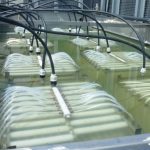
The Membrane Bioreactor (MBR) is an advanced wastewater treatment system that combines biological treatment with membrane filtration technology. Instead of a settling tank, MBR uses microfiltration or ultrafiltration membranes to separate treated water from activated sludge.
This process produces high-quality recycled water with near-complete removal of suspended solids, pathogens, and turbidity. Due to its compact footprint, the MBR wastewater treatment system is ideal for space-constrained facilities, urban developments, and industries targeting maximum water reuse.
MBR-treated water can be reused for industrial processes, cooling towers, landscape irrigation, and as RO plant feed water.
MBR vs MBBR – Key Differences
In terms of space requirements, MBBR systems require larger footprints due to the need for secondary clarifiers, while MBR systems offer a compact wastewater treatment solution suitable for urban and industrial sites with limited space.
Regarding treated water quality, MBBR technology provides reliable biological treatment for discharge compliance, whereas MBR technology delivers reuse-grade effluent suitable for recycling and advanced applications.
From an operational perspective, MBBR plants consume less energy and are easier to operate, making them cost-effective for many industries. MBR plants require higher energy for membrane aeration and cleaning but offer consistent performance, higher recovery rates, and long-term water security.
Applications in Pakistan
In Pakistan’s industrial estates and manufacturing zones, MBBR wastewater treatment systems are commonly implemented where regulatory compliance and robust biological treatment are the primary objectives.
MBR wastewater treatment plants in Pakistan are increasingly adopted by industries, commercial buildings, and institutions aiming for water recycling, zero liquid discharge, and sustainable groundwater management, particularly in Karachi, Lahore, Faisalabad, and Islamabad.
Abamet Pakistan’s Approach
At Abamet Pakistan, we design and deliver custom wastewater treatment solutions based on influent characteristics, space constraints, reuse objectives, and environmental regulations.
For projects requiring cost-effective biological wastewater treatment, MBBR systems remain a proven solution. For facilities focused on high-quality water recycling, environmental sustainability, and ESG compliance, MBR wastewater treatment technology offers superior results.
By implementing advanced sewage treatment plants, industrial effluent treatment plants, and water recycling systems, Abamet Pakistan helps organizations achieve clean water, climate resilience, and long-term sustainability.
Conclusion
Choosing between MBR and MBBR wastewater treatment technologies depends on water reuse goals, available space, regulatory requirements, and operational priorities. With expert engineering and locally proven solutions, Abamet Pakistan enables industries and institutions to adopt the right technology for sustainable wastewater management in Pakistan.